
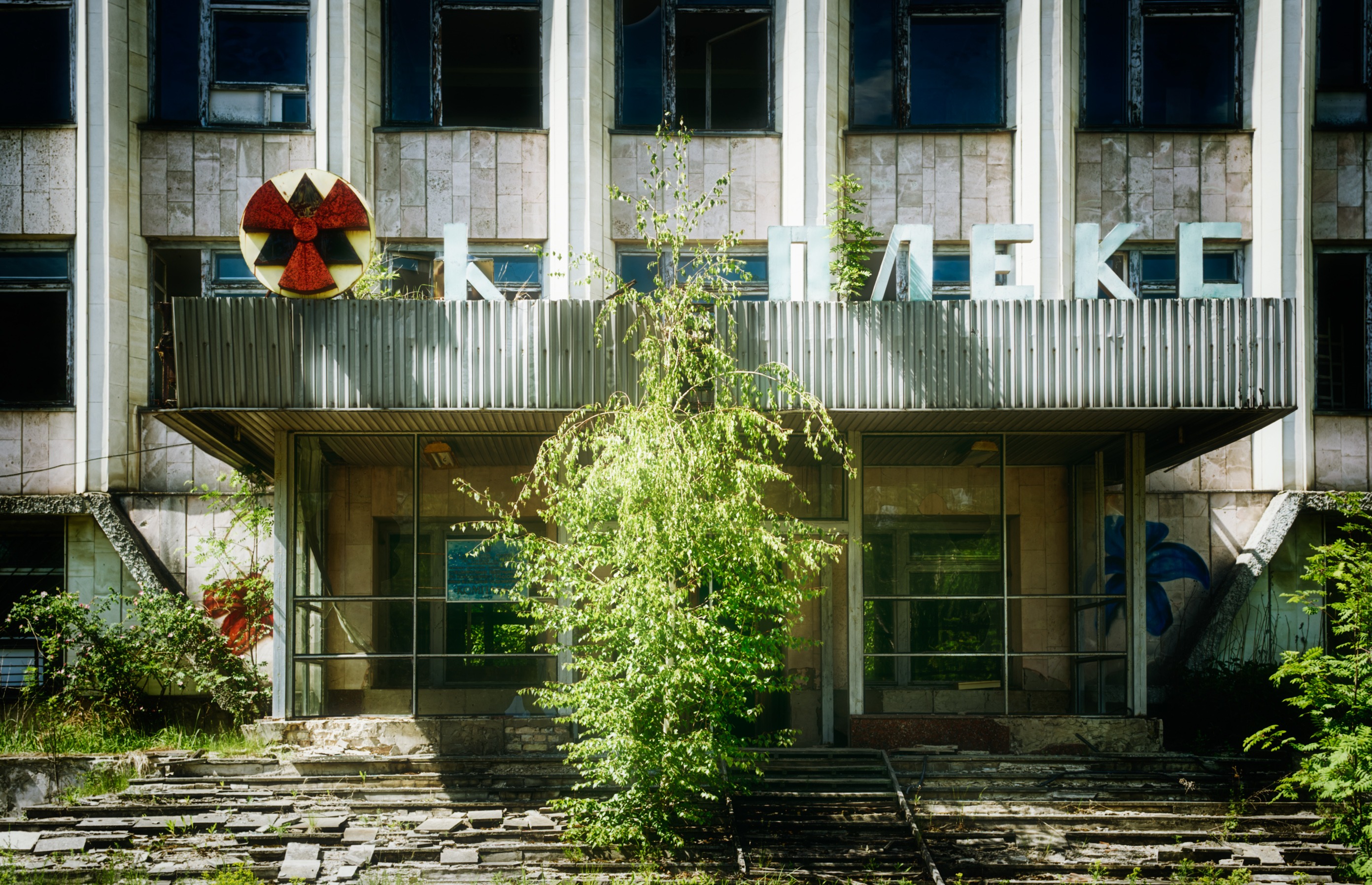
The Lab

This picture was taken in front of some sort of office of the atomic center. It's possible to take a look only from this distance – “I was not allowed to go inside, that could have been quite interesting”, says Bo Nielsen on his web site.

This picture was taken in front of some sort of office of the atomic center. It's possible to take a look only from this distance – “I was not allowed to go inside, that could have been quite interesting”, says Bo Nielsen on his web site.
1. Universal Weak Interactions
Everything you need to know about the wonders of nanotechnology... as a musical... with puppets.
By all accounts, jellyfish are creatures that kill people, eat microbes, grow to tens of meters, filter phytoplankton, take over ecosystems, and live forever. Because of the immense diversity of gelatinous plankton, jelly-like creatures can individually have each of these properties. However this way of looking at them both overstates and underestimates their true diversity. Taxonomically, they are far more varied than a handful of exemplars that are used to represent jellyfish or especially the so-called "true" jellyfish.
This video illustrates the effect of the titanium alloy microstructure. The video was created using 2200 photographs because we didn't have a video camera, but also (and more importantly) because stop motion, even though tedious to shoot, is fun.
To know more about: https://vimeo.com/30299036
Christopher Wilmer’s video ‘High density energy storage using self-assembled materials’ has won a prize in the 2011 NSF International Science & Engineering Visualization Challenge.
Understanding why water is one of the most fascinating and important substances in the universe.
The definition of what a flower is remains an important question in botany. One generally makes a distinction between flowers and inflorescences, although this distinction is not always clear, as in the case of pseudanthia. Pseudanthia are compact inflorescences of small or reduced flowers that mimic a real flower. The structure of a flower is made up from a variable number of building blocks, generally with sepals (a calyx), petals (corolla), stamens (androecium), and carpels (gynoecium). The number and
Are plants intelligent? It would seem so, judging by the program of the new edition of “Evolution Day”, dedicated to the marvelous world of plants and their "intelligence" (Milan, Museum of Natural History, February 10-12th.Scienzainrete will perform the live streaming of the event). In the international panel of speakers stands the Finn Ilkka Hasski, probably the greatest living ecologist (winner of Balzan Prize 2011, and of the Crafoord Prize). Its fame is mainly due to his twenty-year studies on the butterfly Melitaea cinxia in the Åland Islands of Finland, with whom he was able to show
Jürgen Neffe spent 7 months circumnavigating the globe, in order to relive the most famous journey in scientific history: Charles Darwin's travels aboard HMS Beagle. Traveling by boat, camper van, plane, on horseback, and foot, the trained biologist sought out the places where Darwin had gathered the vital information that would lead to his revolutionary theory of evolution - and where his scientific heirs still study life forms today.