fbpx The app for discovering the evolutionary timescale of life | Science in the net

The app for discovering the evolutionary timescale of life

Primary tabs

Read time: 2 mins

Waiting for Evolution Day 2012 celebrations at the Museo Civico di Storia Naturale di Milano on February 10th, 11th and 12th (live streaming on Scienza in rete), it is easy and fun play with TimeTree.

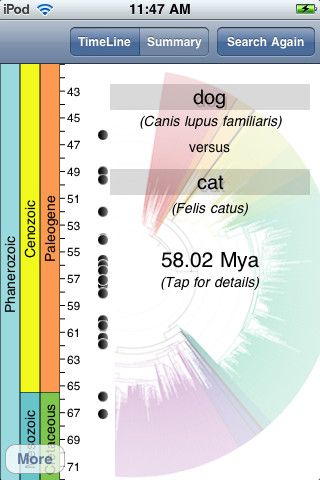
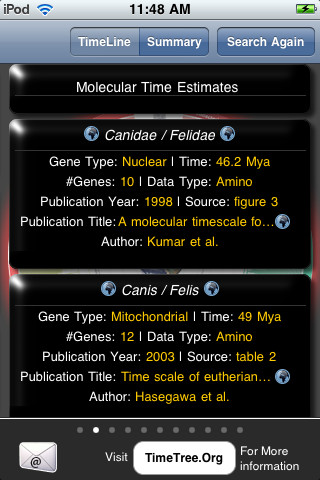
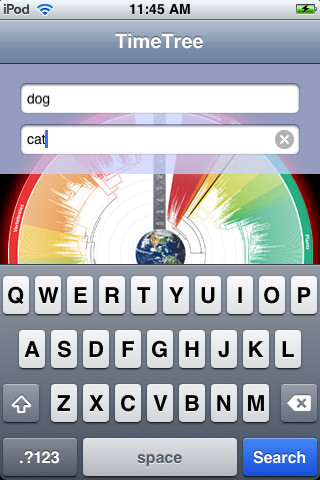
TimeTree is a public knowledge-base for information on the evolutionary timescale of life. This app allows easy exploration of the thousands of divergence times among organisms in the scientific literature. A tree-based (hierarchical) system is used to identify all published molecular time estimates bearing on the divergence of 2 chosen organisms, such as species, compute summary statistics, and present the results. Names of 2 taxa to be compared are entered in the search window and the results are presented on a set of self-explanatory tabs.

For example: the distance between human (Homo sapiens) and ants (formica) is 782.7 milions of years!

TimeTree database version 3.0 was released September 27, 2011 with new data from 1209 studies including 25342 time nodes.
It is possible to send PDFs or at least citations for any studies not included in the database at [email protected]

TimeTree is directed by Blair Hedges (Pennsylvania State University) and Sudhir Kumar (Arizona State University). The project has been supported, in part, by grants from the National Science Foundation, National Institutes of Health, NASA Astrobiology Institute, and Science Foundation of Arizona.

The app is compatible with Apple and Android.

It is of course possibile to do the same search using the TimeTree website.
On the web site you can download also part of the book "The Timetree of Life" (S. Blair Hedges and Sudhir Kumar) and nice posters.

TimeTree: A public knowledge-base of divergence times among organisms. Bioinformatics 22: 2971-2972

Video tutorial and previews of the app:
[video:http://www.youtube.com/watch?v=CxmshZQciwo]

timetree 1 timetree 4timetree 2 timetree 3

Articoli correlati

Scienza in rete è un giornale senza pubblicità e aperto a tutti per garantire l’indipendenza dell’informazione e il diritto universale alla cittadinanza scientifica. Contribuisci a dar voce alla ricerca sostenendo Scienza in rete. In questo modo, potrai entrare a far parte della nostra comunità e condividere il nostro percorso. Clicca sul pulsante e scegli liberamente quanto donare! Anche una piccola somma è importante. Se vuoi fare una donazione ricorrente, ci consenti di programmare meglio il nostro lavoro e resti comunque libero di interromperla quando credi.


prossimo articolo

Nature Restoration Law: We Approve the Law for the Future of European Nature

fenicotteri

On the upcoming July 12, the European Parliament will decide the fate of one of the most ambitious initiatives in support of European nature, the Nature Restoration Law, a legislative proposal aimed at restoring European natural habitats. Now more than ever, it is crucial to defend this law and push for its approval.

In Italy, the Manifesto for the Nature Restoration Law has been published, an initiative that has so far received the support of over 150 associations, 4,000 scientists, dozens of large companies, and over one million signatures from individual citizens (here is the registration form).

Image credits: JD design - Unsplash

Making the protection of nature and the restoration of habitats a legal obligation: this is the purpose of the new European regulation proposal, the Nature Restoration Law. An ambitious proposal, but crucial for making the European Green Deal something concrete.