
The Federal Emergency Management Agency (FEMA) is an agency of the United States Department of Homeland Security (DHS) whose main purpose is to support US citizens to prepare for, protect against, respond to, recover from, and mitigate all kind of hazards.
In order to do so, the agency outlined a series of guidelines to be followed by media and DHS units, regarding incident management media access. These rules are not specifically designed for pandemic response; however, they concern public health communication in emergency and disasters, thus providing an useful example of how a big country deals with risk communication and public health information management.
FEMA obviously recognizes the right of the media to cover federal operations in case of disasters but also poses a series of restrictions to their activity, on the basis of four main elements: national security, law enforcement, safety and local approval. Media must provide proof of credentials in order to participate to the access program and must abide by the final decision of local officers regarding their access to some disaster areas. It is interesting to note that prohibitions coming from local officers are completely outside DHS/FEMA control. Media may have access to classified information but only after being warned in advance of the restrictions on the use of such information. If the exposition to sensitive information was inadvertent, media must be briefed about what they should and should not cover. In case of visits to medical facilities, and interviews or photographs to patients, media are also expected to follow orders and instructions by attending physician. At any time, adult patients may rescind their “informed consent” for interviews or photographs. Unit leaders may rescind that consent too if, to their opinion, this would be in the best interest of that adult patient. Regarding the use of names and pictures of individual casualties, the guidelines pointed out that the deceased are under the responsibility of the respective state until next of kin can be notified, meaning that media should ask for the authorization to report this kind of information to the state authorities. Obviously, medical procedures always have higher priority over anything else.
FEMA guidelines come along with an open letter to media which puts emphasis on the importance of cooperation between emergency units and media operators, implying that both sides would have much to gain from an effective team work. In fact, such a cooperation would provide media with a privileged point of view from which to tell the story of “these brave and proud Americans [...] as they serve their neighbours”, while emergency professionals would have the visibility that they deserve for the service they provide. By referring to some key elements of American narrative – national pride, bravery, cooperation – this letter lays down the basis of a risk communication strategy that should involve both emergency units and media operators.
Guidelines for media during pandemics
prossimo articolo
Discovered a New Carbon-Carbon Chemical Bond
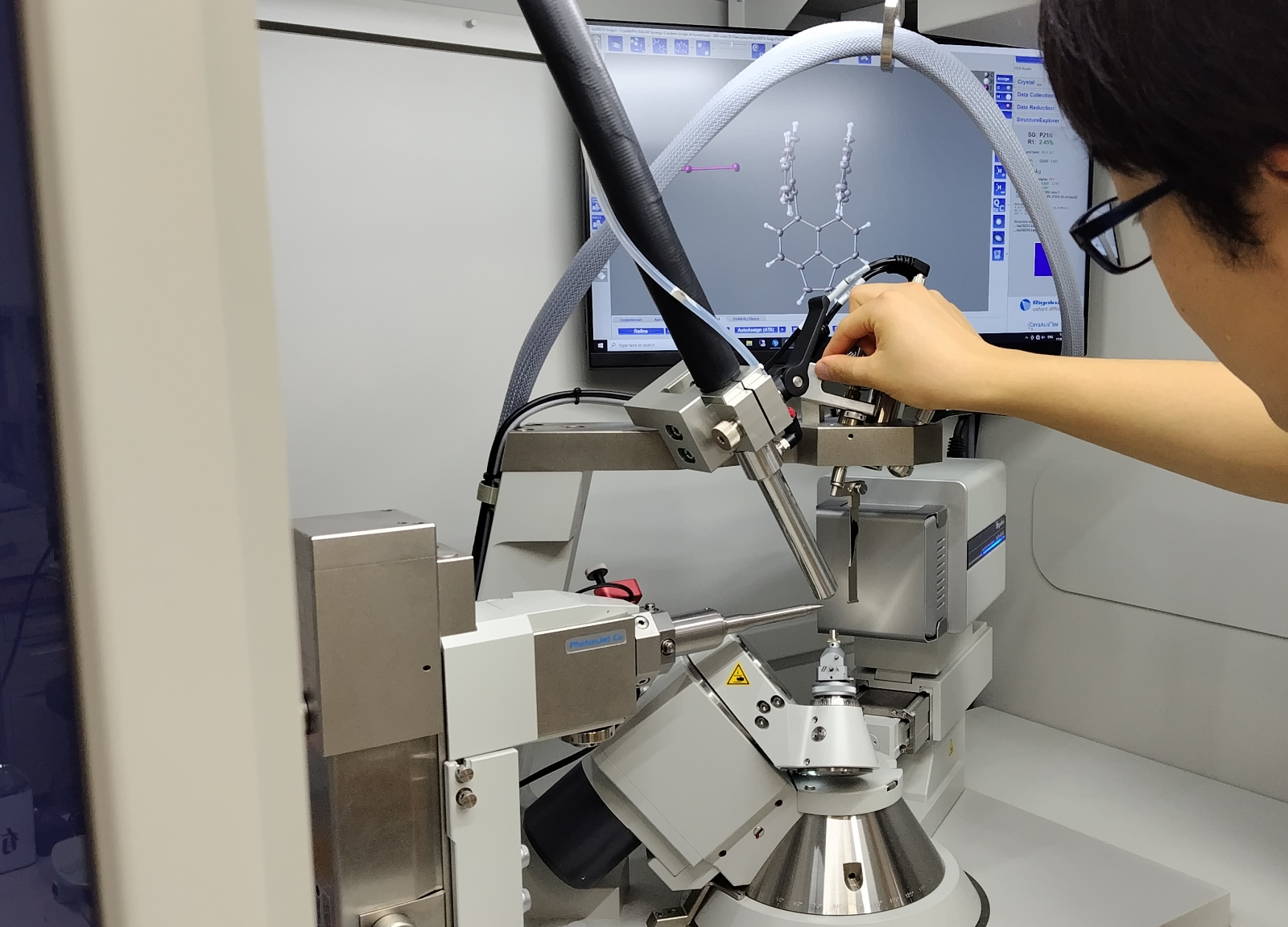
A group of researchers from Hokkaido University has provided the first experimental evidence of the existence of a new type of chemical bond: the single-electron covalent bond, theorized by Linus Pauling in 1931 but never verified until now. Using derivatives of hexaarylethane (HPE), the scientists were able to stabilize this unusual bond between two carbon atoms and study it with spectroscopic techniques and X-ray diffraction. This discovery opens new perspectives in understanding bond chemistry and could lead to the development of new materials with innovative applications.
In the cover image: study of the sigma bond with X-ray diffraction. Credits: Yusuke Ishigaki
After nearly a year of review, on September 25, a study was published in Nature that has sparked a lot of discussion, especially among chemists. A group of researchers from Hokkaido University synthesized a molecule that experimentally demonstrated the existence of a new type of chemical bond, something that does not happen very often.