




fbpx Dove sta andando e dove potrebbe andare l’Organizzazione mondiale della sanità? | Scienza in rete

Dove sta andando e dove potrebbe andare l’Organizzazione mondiale della sanità?

--
Tempo di lettura: 1 min

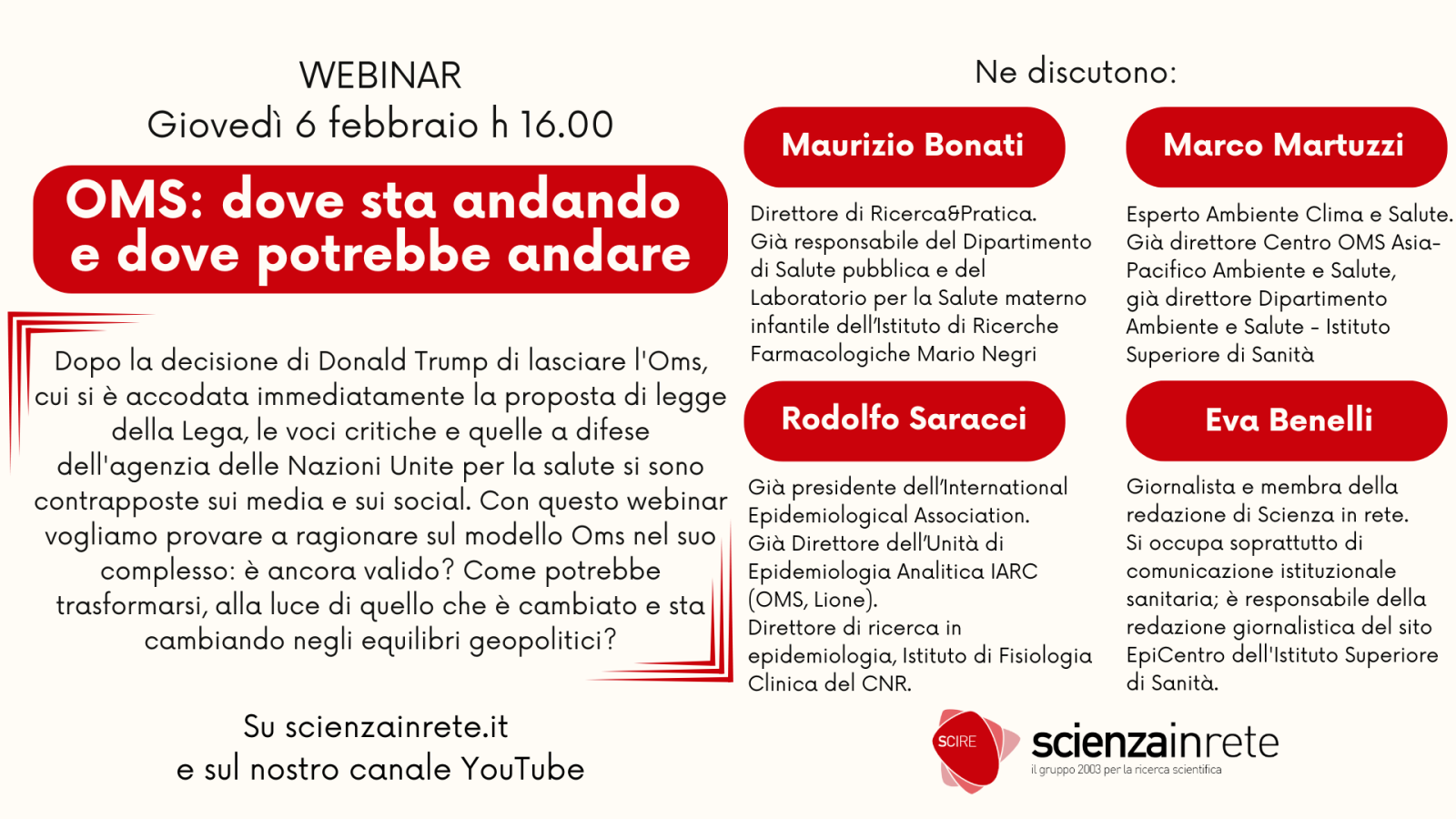
Dopo le diverse reazioni suscitate dalla decisione di Trump di portare gli Stati Uniti fuori dall’organizzazione, Eva Benelli discute con tre esperti - Maurizio Bonati, Marco Martuzzi e Rodolfo Saracci - sul modello Oms nel suo complesso, analizzandone le prospettive e le possibili trasformazioni rese necessarie dai cambiamenti geopolitici.



Scienza in rete è un giornale senza pubblicità e aperto a tutti per garantire l’indipendenza dell’informazione e il diritto universale alla cittadinanza scientifica. Contribuisci a dar voce alla ricerca sostenendo Scienza in rete. In questo modo, potrai entrare a far parte della nostra comunità e condividere il nostro percorso. Clicca sul pulsante e scegli liberamente quanto donare! Anche una piccola somma è importante. Se vuoi fare una donazione ricorrente, ci consenti di programmare meglio il nostro lavoro e resti comunque libero di interromperla quando credi.


prossimo articolo

Why have neural networks won the Nobel Prizes in Physics and Chemistry?

This year, Artificial Intelligence played a leading role in the Nobel Prizes for Physics and Chemistry. More specifically, it would be better to say machine learning and neural networks, thanks to whose development we now have systems ranging from image recognition to generative AI like Chat-GPT. In this article, Chiara Sabelli tells the story of the research that led physicist and biologist John J. Hopfield and computer scientist and neuroscientist Geoffrey Hinton to lay the foundations of current machine learning.

Image modified from the article "Biohybrid and Bioinspired Magnetic Microswimmers" https://onlinelibrary.wiley.com/doi/epdf/10.1002/smll.201704374

The 2024 Nobel Prize in Physics was awarded to John J. Hopfield, an American physicist and biologist from Princeton University, and to Geoffrey Hinton, a British computer scientist and neuroscientist from the University of Toronto, for utilizing tools from statistical physics in the development of methods underlying today's powerful machine learning technologies.