Source: UNFCCC.
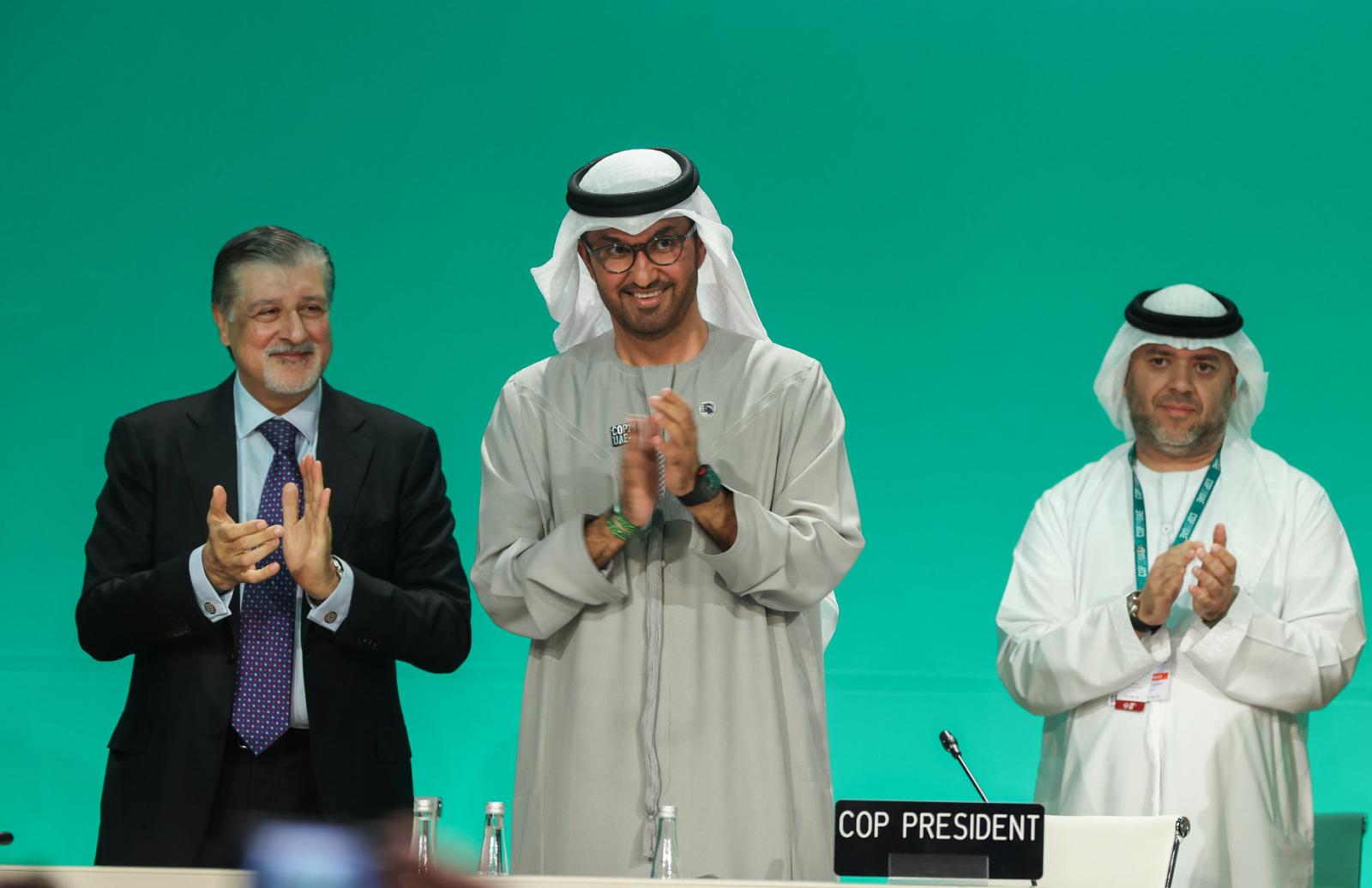
It had to be an oil tycoon to say goodbye to fossils, like the smoker extinguishing his last cigarette and the alcoholic giving up the Negroni. And so it was: for the first time at a United Nations climate change Conference of the Parties, we declare in black and white our desire to abandon coal, gas, and oil. COP28 was held in Dubai, one of the countries most dependent on fossil fuels, and was coordinated by the extremely capable Sultan al-Jaber, president of the largest oil company, ADNOC. It seems like a joke, but perhaps it can also be read as an acknowledgment that the climate transition away from fossil fuels is indeed inevitable for everyone. It was a long and troubled farewell, which will cause us pain before we can finally put an end to coal, gas, and oil. But turning back now seems impossible. In Dubai, right in the Dubai of the astonishing Burj Khalifa and Palm Islands, a piece of sustainability history was made.
The Commitments
The industrial revolution to achieve timely climate neutrality by mid-century must therefore continue by finally recognizing that increasing renewables is not enough. We must necessarily give up fossil fuels. The Global Stocktake says it like this:
Transitioning away from fossil fuels in energy systems, in a just, orderly and equitable manner, accelerating action in this critical decade, so as to achieve net zero by 2050 in keeping with the science.
Abandoning fossil fuels in energy systems in a fair, orderly and equitable manner, accelerating action in this decade to reach climate neutrality by 2050, in line with the science.
The document continues by inviting to triple renewables by 2030 and double energy efficiency. It continues with good intentions also on the necessary adaptation measures, which primarily concern the most vulnerable countries, as well as addressing compensation for the damages and losses (loss and damage) suffered by the countries most affected by the effects of climate disorder. The document recalls the stellar amount of financial resources needed to make these promises concrete, and observes with "significant concern" that, given the commitments made by different countries, the world would be set to stabilize at 2.5-2.8°C of warming rather than well below 2 degrees, i.e., 1.5°C of the Paris Agreement. Moreover, the document notes that the carbon budget still available to stay below the 1.5°C threshold (with a 50% probability) is really limited: less than 500 billion tons of CO2, which is 1/5 of the calculated budget.
Let's leave with a transition away, not a phase out
The final draft of the document arrived at dawn on December 13 after a night of negotiations that dragged on until 4 in the morning. It was also possible - under the watchful eye of the president - to avoid mentioning the phase-out of fossil fuels, replaced by the brilliant alternative "transition away", which is less definitive than phase out but more demanding than phase down, a mere reduction of fuels that appeared in the first draft of the text. OPEC, which brings together the main oil-producing countries, had to intervene with a threatening letter to dictate the line of resistance towards more ambitious formulations. However, towards the end of the Conference, ambitions began to make their way back, crystallizing in a final document that for the first time mentions a roadmap out of fossil fuels, albeit with many convolutions and some omissions. For example, it is significant that coal is only mentioned in terms of a gradual "reduction" and not of phasing it out before the others.
Lunar Goals
The Global Stocktake also recognizes that to stay within the 1.5°C safety threshold, according to the IPCC we should reach the peak of climate-altering gas emissions by 2025. But above all, achieve a 43% reduction in these emissions by 2030 compared to 2019 levels, and 60% by 2035. Lunar goals, which would imply a kind of rebirth that contrasts with the twists and caution of the document. The latter also recognizes that it is time to remove subsidies (but only the "inefficient" ones) from fossil fuels, and that we should also focus on nuclear energy (but without particular emphasis), hydrogen, and the capture and sequestration of CO2, and endorse transitional fuels in anticipation of complete decarbonization. These last concessions are to those who will seek in every way to dilute as much as possible the definitive exit from the fossil fuel era.