Do you remember A Sound of Thunder, a short story by Ray Bradbury published in 1952? During a time travel's safari, the unintentional killing of a butterfly causes several changes at present-days. In chaos theory, the butterfly effect is a phenomenon whereby a minor change in circumstances can cause a large change in outcome. Today, after many years, we could probably speak about the Twitterfly effect.
According to the report Twiplomacy 2013, the governments of 78% of the 193 member states of the United Nations (UN) have a presence on Twitter: personal accounts of heads of state, heads of government and ministers of foreign affairs. Presently, 68% of world leaders have mutual connections with their peers. Microblogging is a formidable broadcasting tool and an indispensable communication channel for international organisations to amplify their messages to a global audience.
The European Organisation for Nuclear Research (@CERN) announced its major science discovery, the Higgs boson, via Twitter. The Nobel Prize committee used Twitter when it was unable to place a phone call to the 2013 Nobel Peace Prize winner, which is the Organisation for the Prohibition of Chemical Weapons (@OPCW). In times of epidemic outbreaks, the World Health Organisation (@WHO) can use Twitter alerts to inform directly the population. In this case, the retweets can amplify the messages or the advices, probably keeping alive many people. The most effective international organisations in terms of number of retweets are @CERN, the United Nations Children's Fund (@UNICEF), the United Nations Organisation (@UN), the World Wide Fund for Nature (@WWF), @Greenpeace and @WHO.
What about our country? At the end of 2013, the number of Twitter users in Italy was approaching 10 million. However, it is interesting to note that only 35% of them (3.4 million) were monthly active users. Furthermore, 64% of active users log on to Twitter using a smartphone or a tablet. We tried to analyze the use of microblogging in some important institutions such as the public universities. As stated by the ranking drawn up in June 2012 by the Ministry of Public Education, the best Italian public universities are Politecnico di Torino (@PoliTOnews), Politecnico di Milano (@polimi), University of Venice Ca' Foscari: (@CaFoscari) and University of Bologna (@UniboMagazine). Is it the same in Twitter? According to its Application Programming Interface, we could read the last 3200 tweets for every account.
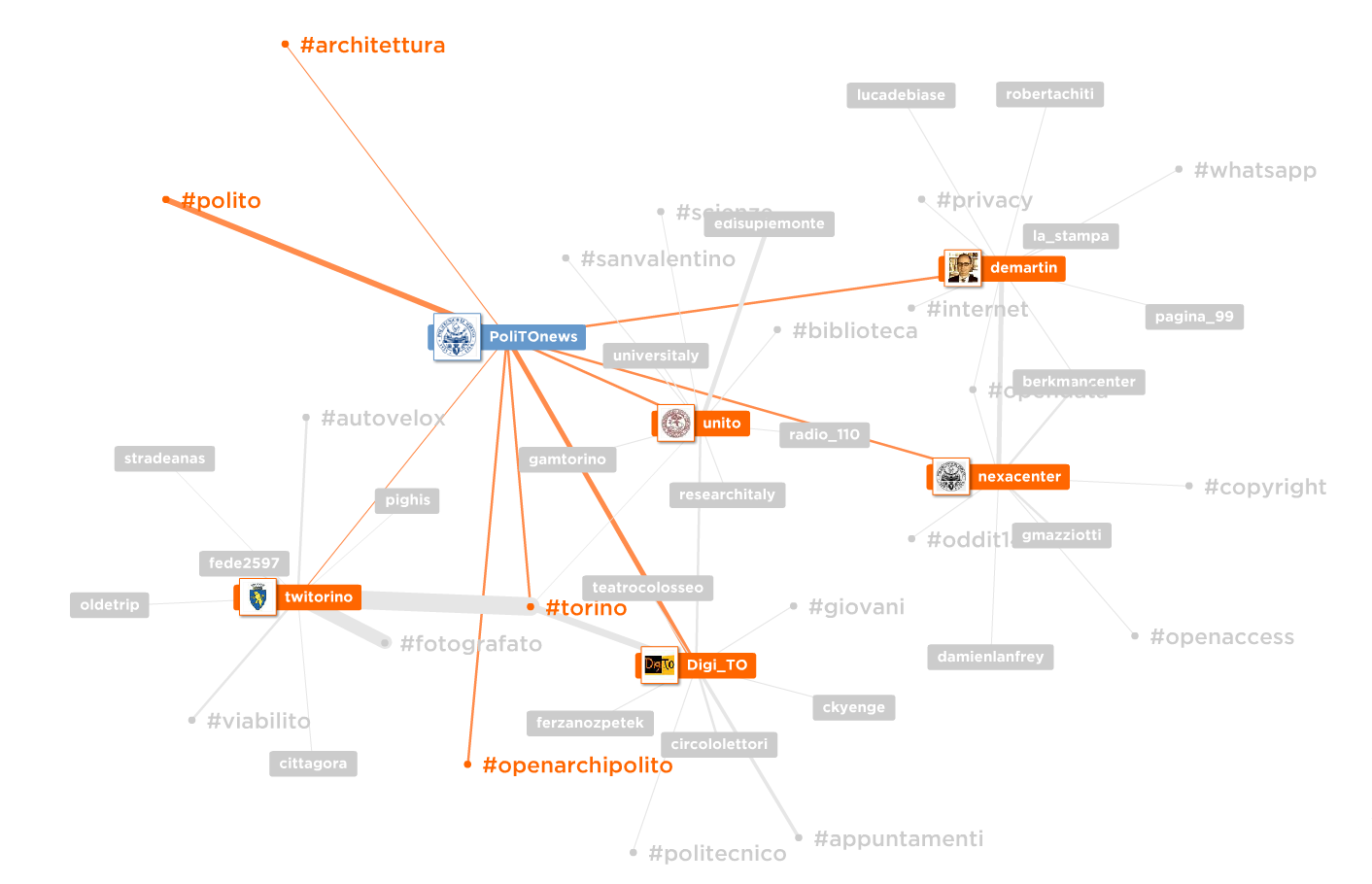
As of 27th February 2014, the first account had 4598 followers with 682 tweets (0.92 per day from 17th February 2012). The user mentions were 154 (0.23 per tweet) and the replies were 55 (8%). The higher these numbers, the more this user interacts with others. Furthermore, 232 tweets (34%) were retweeted for a total of 594 times (2.56 per tweet) and 88 tweets (13%) were favorited for a total of 137 times (1.56 per tweet). The higher these numbers, the more this user is considered a valuable source of information by others. @PoliTOnews used 447 hashtags (0.66 per tweet): #polito (99), #politecnico (38), #orientatialfuturo (32), #giorniairc (16), #scienceandthefuture (11), #smart (9), #torino (7), #terremoto (7), #openarchipolito (7), #orientamento (7).
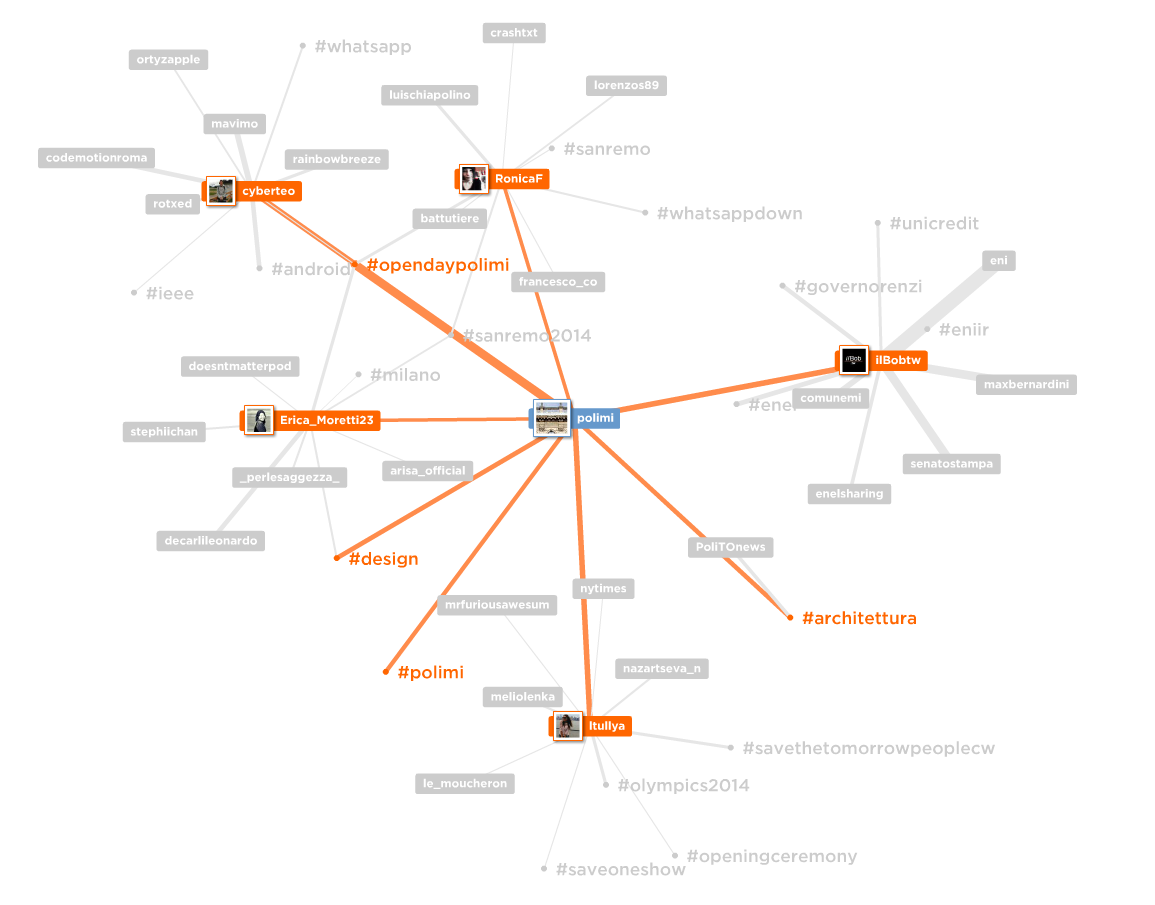
@polimi had 13867 followers with 2890 tweets (2.64 per day from 28th February 2011). The user mentions were 1633 (0.57 per tweet) and the replies were 668 (23%). Furthermore, 1375 tweets (48%) were retweeted for a total of 3948 times (2.87 per tweet) and 581 tweets (20%) were favorited for a total of 877 times (1.51 per tweet). This user used 1413 hashtags (0.49 per tweet): #polimi150 (297), #youtube (137), #inaugurazionepolimi (113), #opendaypolimi (66), #architettura (56), #mypoli (49), #design (34), #ricerca (21), #studenti (19), #giocoestate (18).
@CaFoscari had 7774 followers with 3192 tweets (2.89 per day from 21st February 2011). The user mentions were 571 (0.18 per tweet) and the replies were 80 (3%). Furthermore, 971 tweets (30%) were retweeted for a total of 1994 times (2.05 per tweet) and 397 tweets (12%) were favorited for a total of 647 times (1.63 per tweet). This user used 1345 hashtags (0.42 per tweet): #cafoscari (540), #ricerca (41), #cfdw13 (39), #artn12 (37), #artnightvenezia (37), #venezia (37), #cafoscari13 (16), #venetonight (13), #video (12), #ca (12).
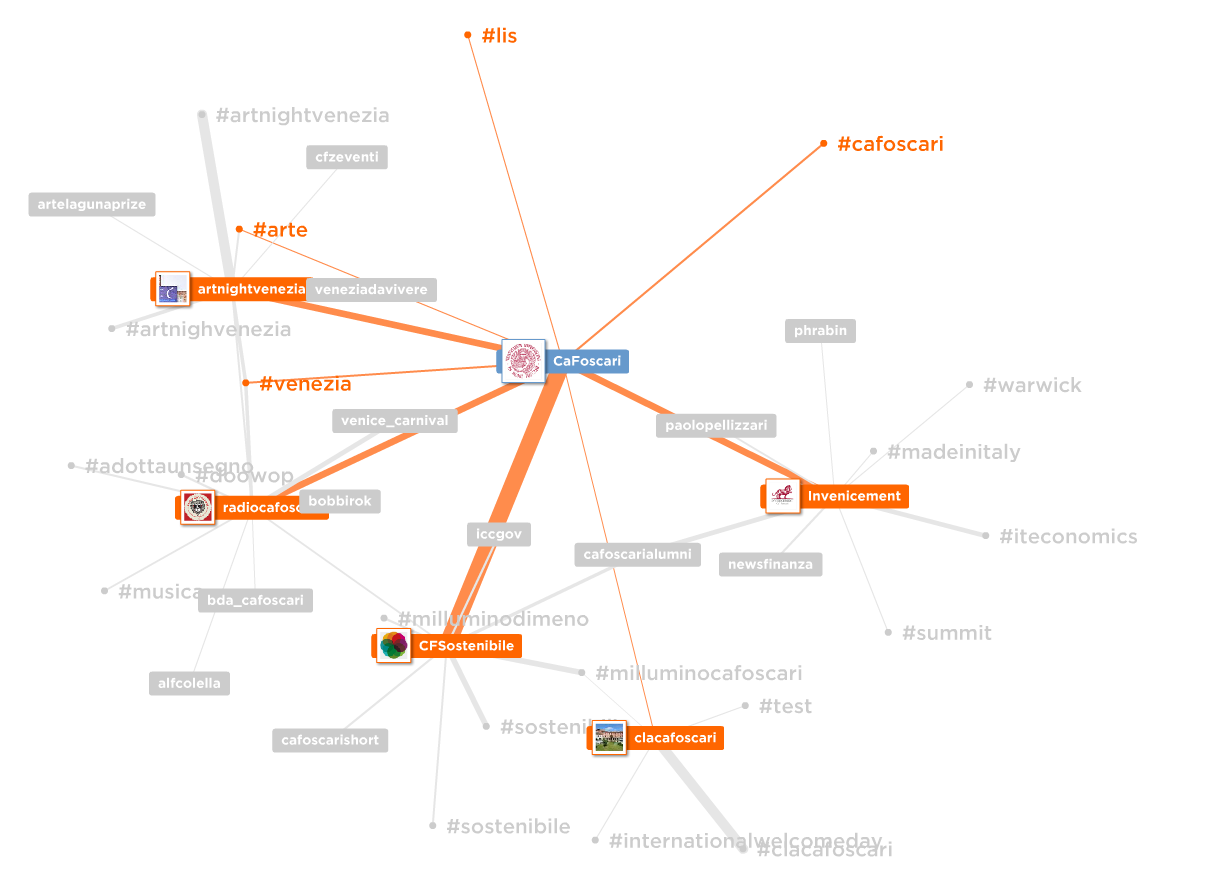
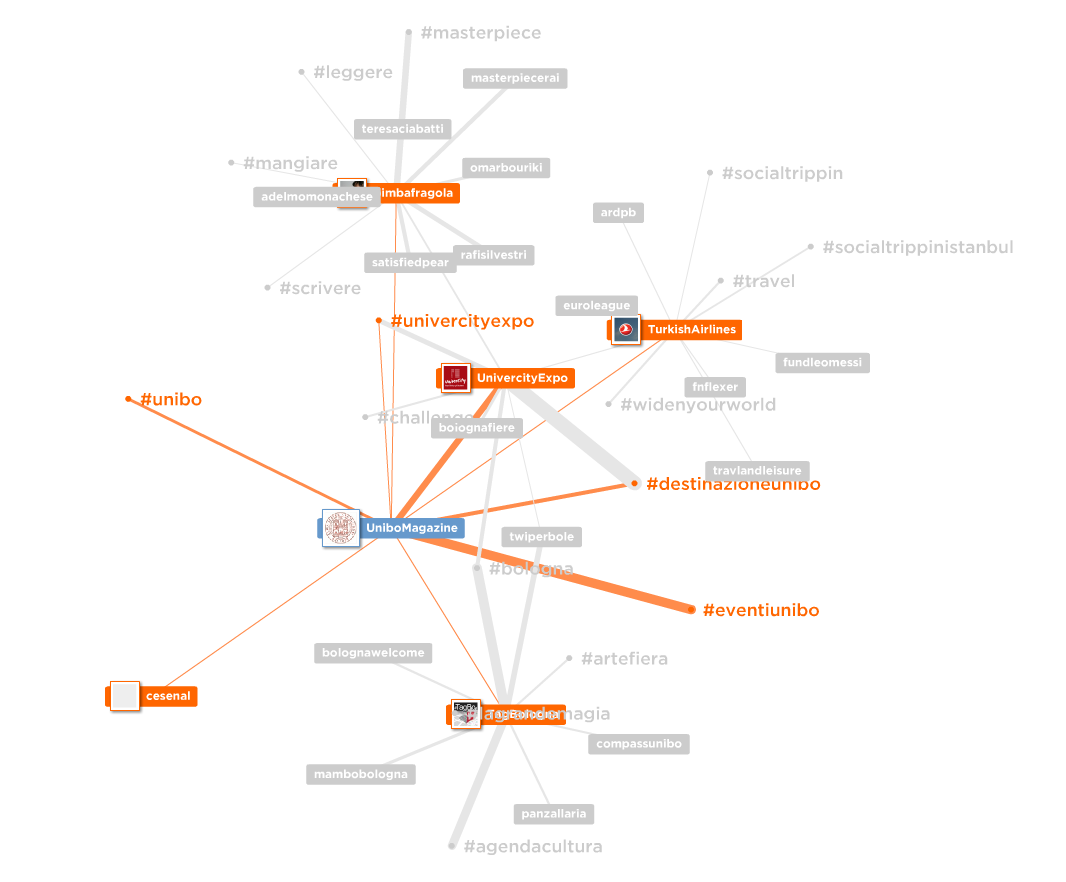
@UniboMagazine had 5874 followers with 3200 tweets (8.99 per day from 9th March 2013). The user mentions were 93 (0.03 per tweet) and the replies were 25 (1%). Furthermore, 931 tweets (29%) were retweeted for a total of 1637 times (1.76 per tweet) and 534 tweets (17%) were favorited for a total of 759 times (1.42 per tweet). This user used 1657 hashtags (0.52 per tweet): #eventiunibo (1230), #unibo (275), #5permilleunibo (55), #aungsansuukyi (23), #destinazioneunibo (9), #nobel (8), #almaorienta (8), #careerday (8), #ff (7), #pace (5).