
For the first time, four of the world’s leading research university associations have made a joint statement on the characteristics of contemporary research universities. The four associations -- the Association of American Universities (AAU), the Consortium of China 9 Research Universities (C9), the Group of Eight Australia (Go8), and the League of European Research Universities (LERU) issued the statement at the annual meeting of the C9 universities in Hefei, China. “This statement articulates the key characteristics of research universities that enable them to fulfil their research and education missions,” said Professor Jianguo Hou, President of The University of Science and Technology, China, and C9 convenor for 2013. ”It outlines the shared values that underpin effective crossnational institutional collaboration,” he added. “Research universities can work together across borders and across oceans to make far-reaching contributions to problem solving and innovation around the world,” said Professor Hunter Rawlings, AAU President. “The statement identifies not only institutional responsibilities but also the need for government policies that support the values and cultivate those basic strengths of research universities that enable them to serve their nations well,” he added. The four associations, which comprise the leading research universities in their respective regions, have committed to work together to advance the 10 characteristics described in the joint statement and also explore prospects for additional collaborations. “We will explore expanded future collaborations among our students, scholars and researchers,” said Professor Bernd Huber, LERU Chair. “We will pursue the possibilities for joint work addressing global research issues, including structured dialogue with the recently formed Global Research Council, perhaps through the formation of a Global Council of Research Universities”, he said. The four groups are keen to extend commitment to the research university characteristics by inviting comparable associations of research universities to sign onto the Joint Statement. “We see this statement as the beginning of an important process of deepening community understanding of what research universities are and what they can be, and of their unique role in meeting global challenges,” said Professor Hilmer, Go8 Chair.
Hefei Statement, 10 characteristics of research universities
prossimo articolo
Discovered a New Carbon-Carbon Chemical Bond
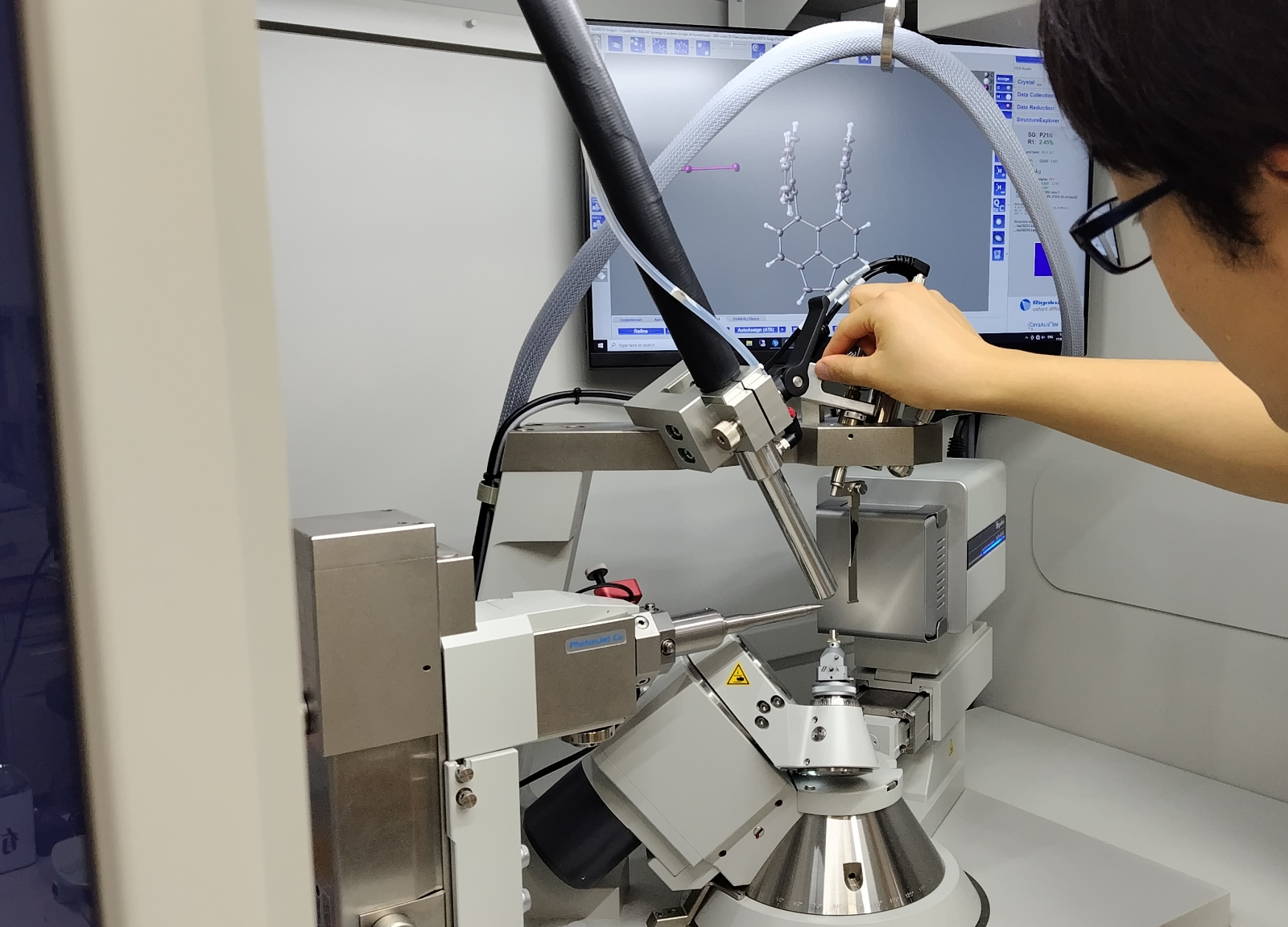
A group of researchers from Hokkaido University has provided the first experimental evidence of the existence of a new type of chemical bond: the single-electron covalent bond, theorized by Linus Pauling in 1931 but never verified until now. Using derivatives of hexaarylethane (HPE), the scientists were able to stabilize this unusual bond between two carbon atoms and study it with spectroscopic techniques and X-ray diffraction. This discovery opens new perspectives in understanding bond chemistry and could lead to the development of new materials with innovative applications.
In the cover image: study of the sigma bond with X-ray diffraction. Credits: Yusuke Ishigaki
After nearly a year of review, on September 25, a study was published in Nature that has sparked a lot of discussion, especially among chemists. A group of researchers from Hokkaido University synthesized a molecule that experimentally demonstrated the existence of a new type of chemical bond, something that does not happen very often.