
fbpx Fourteen Italian voices within the Horizon 2020 Committee | Page 9 | Science in the net

Fourteen Italian voices within the Horizon 2020 Committee

Read time: 1 min

The Italian Minister for Education, University and Research, Maria Chiara Carrozza, appointed the national representatives for the Horizon 2020 Committee, with the aim of preparing our country to the new Framework Programme for European Research (2014-2020).

According to the Minister, an active and continuous presence of our representatives is necessary to get a quote of the funding that, at least, equals the Italian budgetary contribute to the Programme – something that did not happen in the FP7. Also, the whole national systems of research, innovation and of course politics have to offer their support. The Minister for Education, University and Research will be on the frontline in Bruxelles, to highlight the role of country with such a remarkable scientific and industrial tradition as Italy.

The fourteen Italian members of the Committee (seven men and seven women) are thus called to represent Italy in Europe, within their specific fields of expertise.

Source: MIUR
Autori: 
Sezioni: 
Horizon 2020

prossimo articolo

Why have neural networks won the Nobel Prizes in Physics and Chemistry?

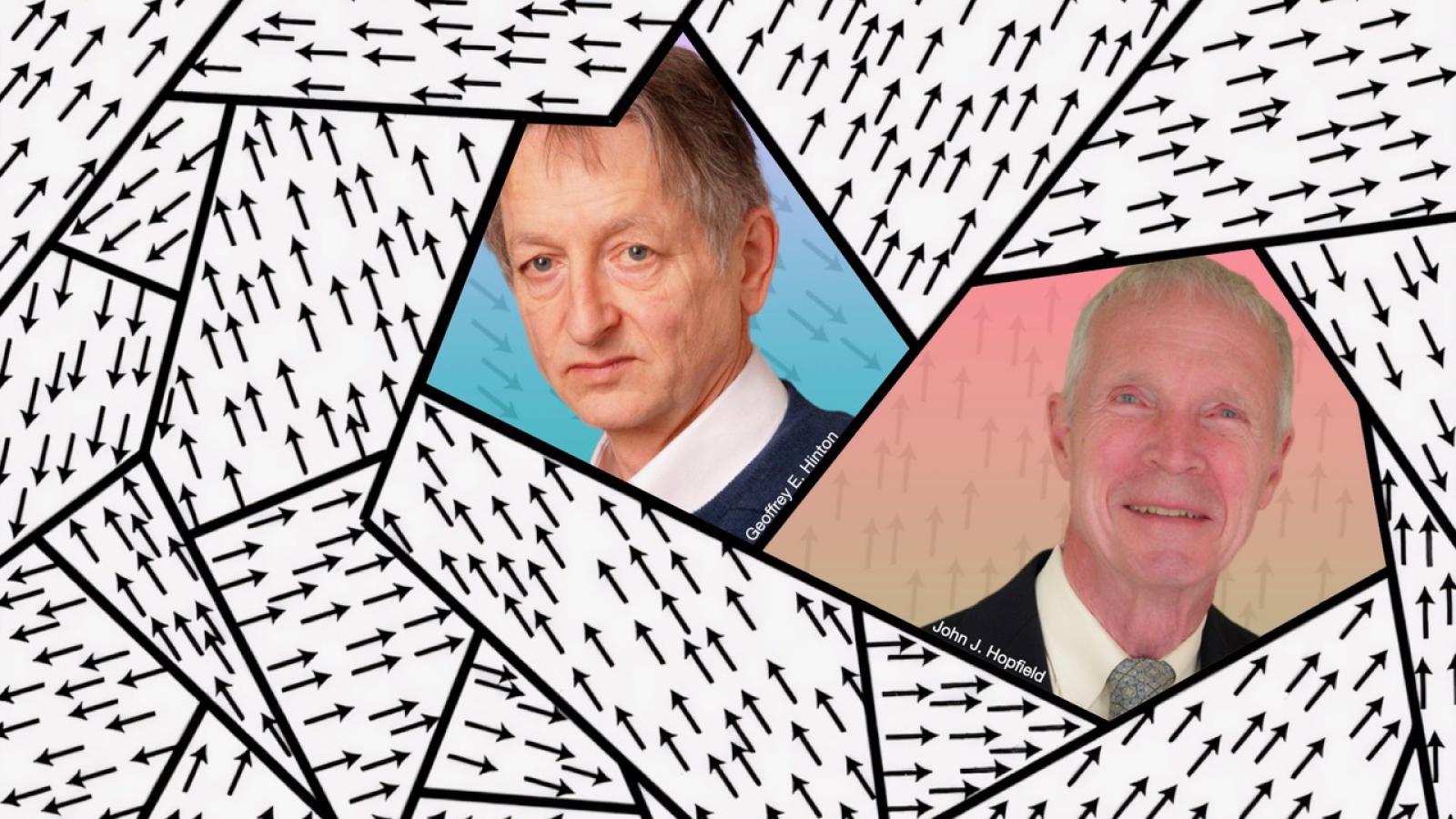
This year, Artificial Intelligence played a leading role in the Nobel Prizes for Physics and Chemistry. More specifically, it would be better to say machine learning and neural networks, thanks to whose development we now have systems ranging from image recognition to generative AI like Chat-GPT. In this article, Chiara Sabelli tells the story of the research that led physicist and biologist John J. Hopfield and computer scientist and neuroscientist Geoffrey Hinton to lay the foundations of current machine learning.

Image modified from the article "Biohybrid and Bioinspired Magnetic Microswimmers" https://onlinelibrary.wiley.com/doi/epdf/10.1002/smll.201704374

The 2024 Nobel Prize in Physics was awarded to John J. Hopfield, an American physicist and biologist from Princeton University, and to Geoffrey Hinton, a British computer scientist and neuroscientist from the University of Toronto, for utilizing tools from statistical physics in the development of methods underlying today's powerful machine learning technologies.