If continuity means importance, research and energy have been confirmed as a priority for the European Union, at least in its Parliament. Despite the challenging election of the new Parliament, on the scientific point of view nothing seems to be changed. On the 7th of July, Jerzy Buzek has been nominated Chair of the Industry, Research and Energy Committee (ITRE), one of the most relevant committee of the EU Parliament. This nomination has a deep political meaning, along with that of the vice-chairs.
Excellent in scientific research, excellent in politics: Jerky Buzek's career
Jerky Buzek, a former Polish Prime Minister, is an important politician in the EU Parliament. Son of an engineer, he took the doctoral degree and became scientist in Chemical Engineering at Polish Academy of Science. Then, after the fall of the communist regime, he entered the world of politics, successfully: he became Prime Minister of Poland from 1997 to 2001, the first democratic PM to serve a full term. In 2001, he did a step back from politics and returned into scientific research, becoming Pro-Rector at the Akademia Polonija and Professor of Chemical Engineering at the Opole University of Technology. However, after just three years he came back in politics, being elected for the first time at the EU Parliament: he immediately entered the ITRE until 2009, when he was elected President of the European Parliament, with the largest majority ever. When he ended his mandate as President, in 2012, he entered the EU Parliament Foreign Affair Committee. After this year elections, he has been re-elected as Member of the European Parliament (MEP) and now he has become President of the ITRE.
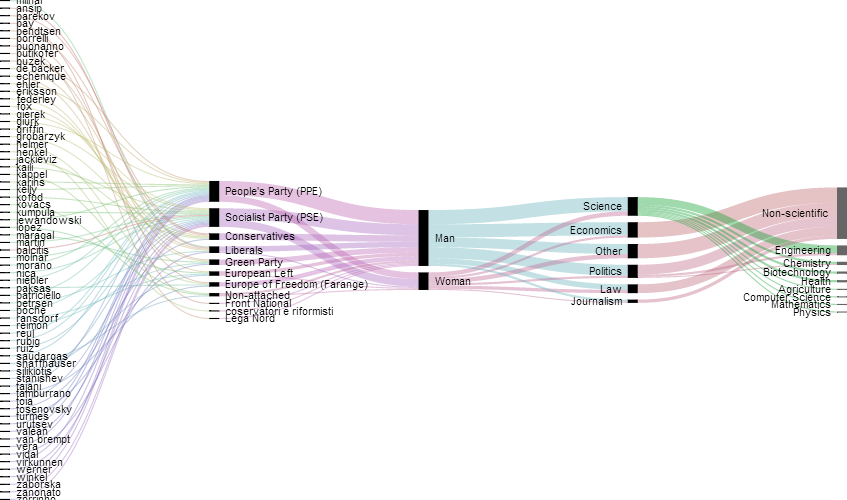
Scientists and non-scientist in ITRE committee
The vice-chair nomination and the other members of ITRE
The scientific and political path of Jerky Buzek, a former PM and President of the Parliament, is a clear sign of the importance of the committee. Moreover, he has proved a strong conviction in the European integration. This can probably enforce all the financial subsidies structure of the EU, first of all Horizon 2020. But another political sign of the ITRE importance can be found in the nomination of the first two vice-chairs: both of them were ITRE vice-chairs during the previous legislature: excellence in the head, continuity in the body. As a matter of fact, the Italian Socialist/Democrat MEP Patrizia Toia has been confirmed as the first vice-chair, having served in that position since 2009, and, as the second vice-chair, the Czech MEP Miloslav Ransdorf, who also served in the same position since 2004. A newcomer in third position of vice-chair is the German MEP Hans Olaf-Henkel, a former top manager of IBM Europe. The real fight has been about the fourth position, harshly contended by two candidates: Dario Tamburrano, an euroskeptic Italian MEP (from Movimento 5 Stelle in coalition with the Nigel Farange's Europe for Freedom Party), and Morten Helveg Petersen, a liberal MEP from Denmark. The latter won with 37 votes in favor against 17, but Tamburrano denounced a partition of positions between the three major European political parties.
First declarations
Although the first meeting, held in July 22nd, had a procedural agenda, Buzek immediately set the mid-term priorities for his presidency. First of all, a genuine discussion about the ongoing diplomatic negotiations on the EU-US Treaty, as it will have deep implications on the energy sector. Then he set the digitalization, energy security and re-industrialization as a more general issues to be discussed. He did not mention any discussion about scientific policies, which is something that can be seen as something good, or bad.