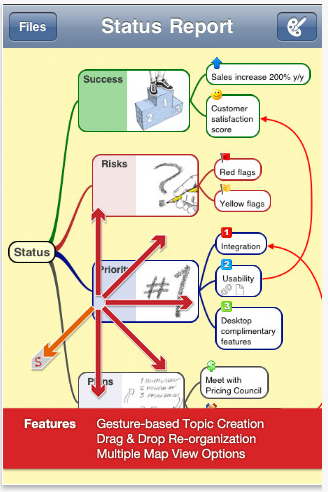
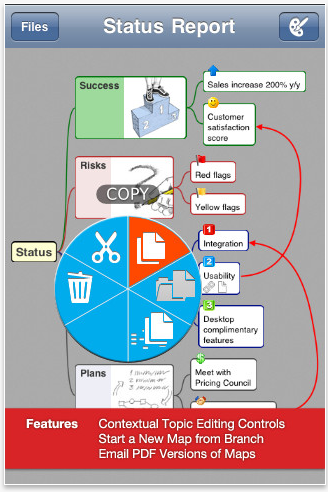
The mind map allows you to have an overview of an idea, to understand how it is structured and organized, its connections and relationships. By visually summarizing the main properties of a thought or a project, the mind map facilitates its organization, its understanding and memorization.
Mind maps are generally based on hierarchy and associations, and connections can be of 2 types:
- Hierarchical connections (or branches) connecting each element with the previous one
- Associative connections (or associations) connecting elements that are not hierarchically linked together
The key idea is at the center of the mind map and is connected via the hierarchical links to the first-level elements. First-level elements can be connected to second- level elements, second level elements to third-level elements and so on. Elements that are far apart and not hierarchically linked can be connected through associations.
Generally, the graphic layout of all elements of a mental map is radial, but it can also be a herringbone or tree layout.
When you first use of the app it is very useful to read the "Basic Gestures" item in the help (?) in order to understand how to perform basic operations and to experiment with the app. It is important however that you do not save the changes made.
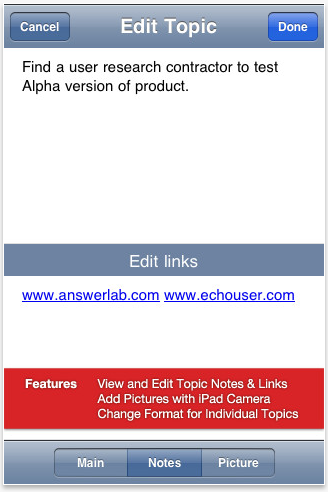
Since the mind map is a useful mnemonic tool, it is important to use colors, symbols, pictures or images when creating each element.
The name of each element should be brief and meaningful.
Video overview and previews of the app:
[video:http://vimeo.com/32367415]