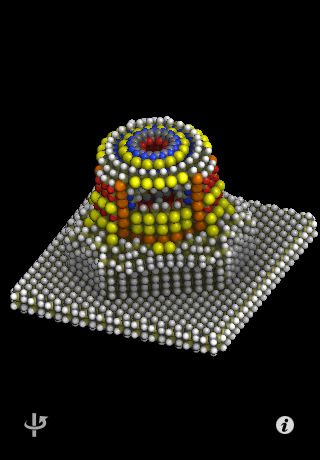
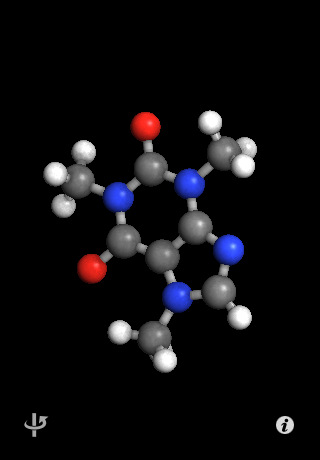
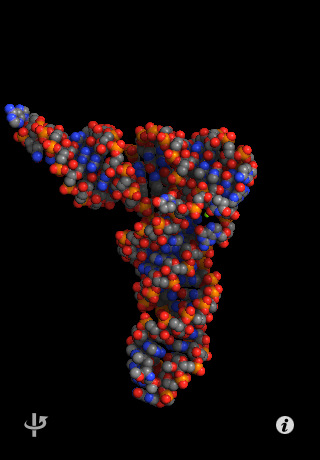
Molecules is an application for viewing three-dimensional renderings of molecules and manipulating them using your fingers. You can rotate the molecules by moving your finger across the display, zoom in or out by using two-finger pinch gestures, or pan the molecule by moving two fingers across the screen at once. These structures can be viewed in both ball-and-stick and spacefilling visualization modes.
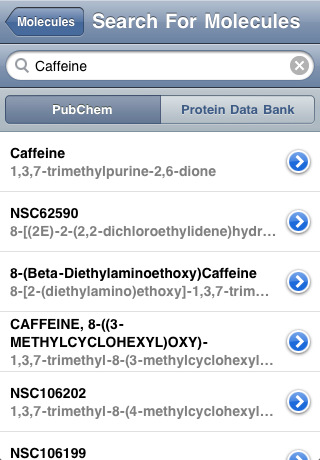
New molecules can be downloaded from the RCSB Protein Data Bank, an international repository of biological molecules and their 3-D structures, or NCBI's PubChem, a public database of compounds. Molecules can be downloaded directly to your handheld device and stored there for later viewing. It is also possibile to view detailed information about the molecule, such as the researchers who established its structure, its amino acid or nucleotide sequence, and its full name. Multiple visualization modes can be switched to by double-tapping on the 3-D rendering.
Custom molecular structures can be downloaded to the application via iTunes file sharing, or from any publicly available web server. The location of these structures can either be manually specified in the application, or custom URLs, such as molecules://www.sunsetlakesoftware.com/sites/default/files/neonPump.pdb.gz , can be clicked on within Safari or Mail on the device. This will launch Molecules and have it start downloading the file at that address.
Molecules is free and its source code is available under the BSD license.
Video review and preview of the app:
[video:http://www.youtube.com/watch?v=Mf33YEScPPQ]
Video review by iguitardude2744