If you have an apple and I have an apple and we exchange these apples then you and I will still each have one apple. But if you have an idea and I have an idea and we exchange these ideas, then each of us will have two ideas.
Probably, George Bernard Shaw used this quote to encourage his readers to have a greater participation in events and a wider exchange of ideas. In the same spirit, from 6 to 8 November 2013, nearly 6000 participants attended the event ICT2013 in Vilnius (Lithuania), including several highly esteemed speakers. For instance Neelie Kroes , Vice-President of the European Commission responsible for the Digital Agenda, who spoke during the session Innovating by exploiting big and open data and digital content [Link: Speech]. Nearly 200 exhibitions were opened for the visitors, who could join over 180 networking sessions about Information and Communication Technology (ICT). Furthermore, many people could follow the conference via social media or live streaming.
Many researchers, innovators, entrepreneurs, industry representatives, common people and politicians discussed for three days on latest ICT developments and Horizon 2020, the EU's Framework Programme for Research and Innovation for 2014-2020. In particular, the stakeholders exchanged their viewpoints on five main exhibits themes: (1) digitally empowered citizens; (2) smart and sustainable cities for 2020+; (3) industry, business and work for tomorrow; (4) intelligent connecting intelligence; (5) culture, science and creativity .
Horizon 2020 will be officially launched in December 2013 with ca. 86 billion Euro of funding. An important part of this budget, around 13 billion Euro, has been allocated to support ICT and digital research and innovation over the whole period. In fact, this is probably a very well choice because ICT can influence economy, society and science successfully, but it can also create some new jobs. Concerning ICT research, Horizon 2020 has been specifically designed to attract small and medium enterprises (SMEs), which are more than 99% of all European businesses as defined in EU law.
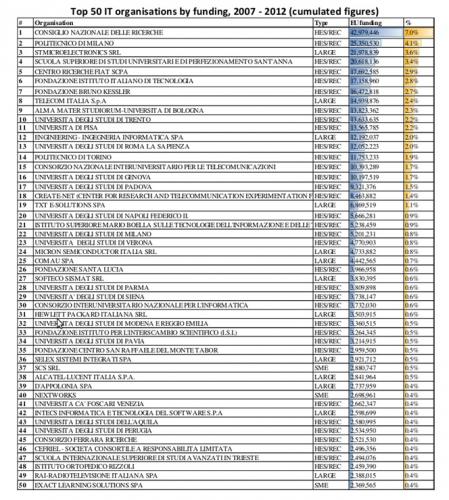
What about our country? According to the document Italy: ICT R&D and participation to FP7, more than 750 Italian organisations have been very active in the FP7-ICT Programme over the period 2007-2012. With an overall budget of ca. 613 million Euro (10% of the total), they participated to 2122 projects (11.7% of the total) and coordinated 237 activities. Large enterprises, with more than 250 employees and a turnover of at least 43 million Euro, accounted for 24% of total funding allocated, whereas SMEs accounted for 12%.
Our country is very good represented in the Future and Emerging Technologies (FET) area, as well as in ICT for health. As reported in the report, it has also a key role in technology areas such as embedded systems, cognitive systems and robotics, trustworthy ICT and software and services. Funding is mainly directed towards big cities such as Milan, Rome and Turin, but also the National Research Council (CNR) and many universities or polytechnics (63% together).
Figure 1 (Source: Italy: ICT R&D and participation to FP7)
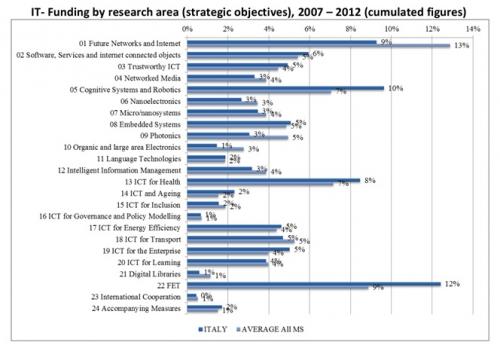
Figure 2 (Source: Italy: ICT R&D and participation to FP7)