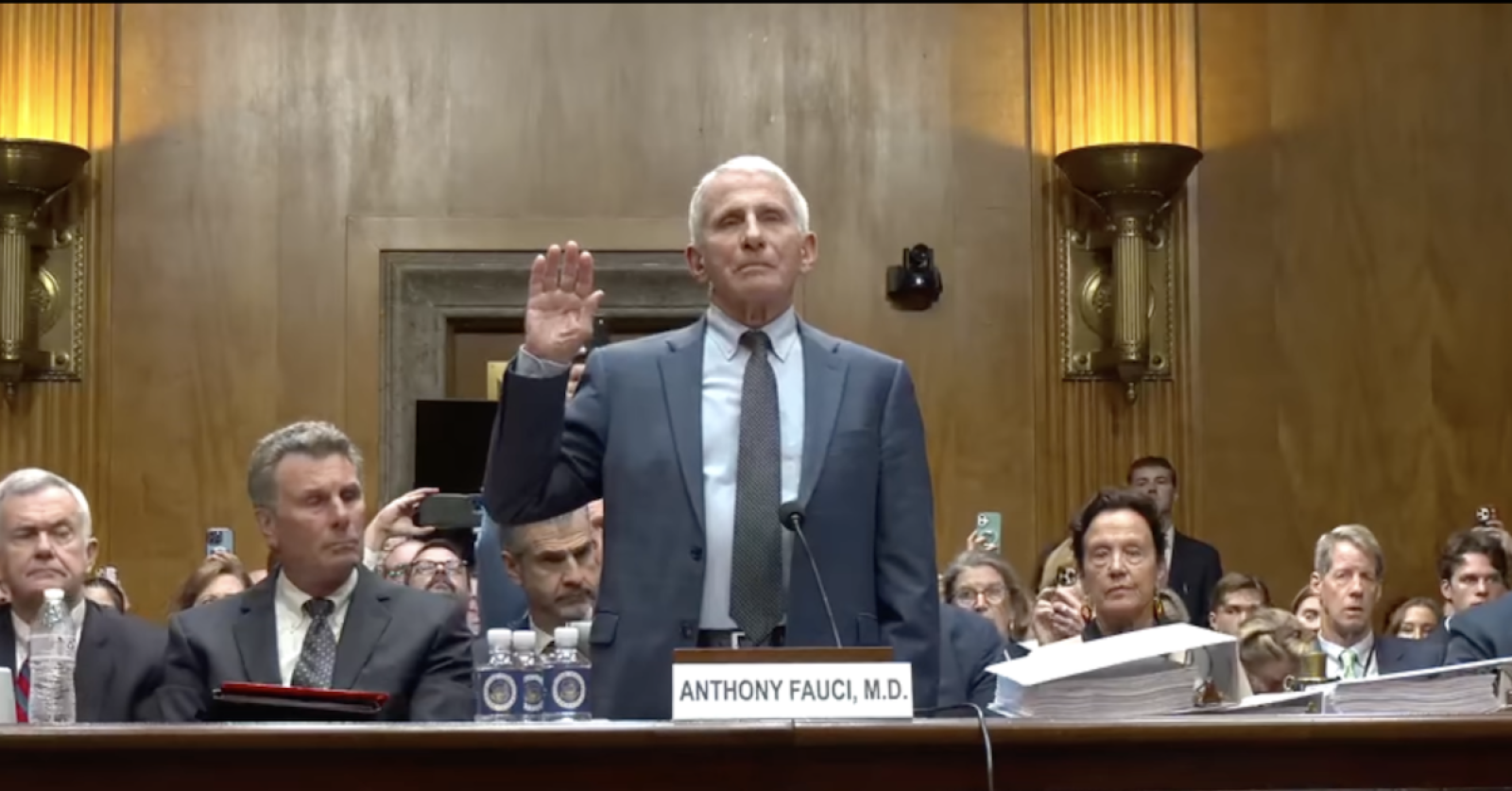
Anthony Fauci, at 85, has been called to testify before the Senate committee investigating the origins of the Covid-19 pandemic, in what feels like a settling of scores by the very party that, at the time, was recommending chloroquine as a defence. The eminent physician is once again at the centre of controversy, not least for choosing to invoke the Fifth Amendment rather than answer questions. Guido Poli, immunologist at the San Raffaele Hospital and president of Patto Trasversale per la Scienza, who worked with him for many years, recalls in this article Tony Fauci's battles in the history of American and international public health, from AIDS to the pandemic. The image is taken from the footage (public domain) of A. Fauci's hearing on 29 July 2026 before the Senate Homeland Security and Governmental Affairs Committee.
In recent days, Anthony (“Tony”) Fauci has once again become a prominent figure in the international media, and to some extent in Italy as well. As the physician-scientist who has played one of the leading roles in U.S. public health over the past several decades, he became known throughout the world during the darkest days of the COVID-19 pandemic. Having had the privilege and good fortune to work with him from 1986 to 1993, I would like to offer my personal account of the scientist and the man.
I wish to make clear that I do not intend to weigh in on the still unresolved question of the origin of the SARS-CoV-2 virus, whether it emerged naturally from an animal reservoir that has nonetheless never been identified, or escaped from the laboratory in Wuhan, where bat coronaviruses were being studied after “gain-of-function” mutations had been introduced to investigate the viruses’ potential to spread to humans. This issue lies at the heart of the accusations brought against Fauci by some Republican senators, particularly Rand Paul. They accuse him of having funded, as Director of the National Institute of Allergy and Infectious Diseases (NIAID), collaborative research between the United States and China on the pandemic potential of bat coronaviruses.
Tony Fauci is one of the world’s best-known physician-scientists. Born in Brooklyn, New York, and educated by the Jesuits, he had such an outstanding career in medicine and science that, at the age of just forty-three, he was appointed Director of one of the U.S. government’s research institutes in Bethesda, Maryland, in 1984, the youngest person ever to hold such a position. Bethesda, located just outside Washington, D.C., is home to the National Institutes of Health (NIH), the world’s largest publicly funded biomedical research center, employing approximately 18,000 scientists, many of them from overseas.
Fauci went on to serve as Director of the National Institute of Allergy and Infectious Diseases (NIAID) for the next thirty-eight years. At the same time, he remained Chief of the Laboratory of Immunoregulation, where I arrived in 1986 and worked for seven years before returning to Italy. Those were the defining years of the AIDS epidemic, and Fauci transformed NIAID into one of the world’s leading centers for immunology and infectious disease research by increasing its budget from less than $400 million to more than $6 billion by 2023 and expanding its research beyond HIV/AIDS to infectious diseases more broadly.
My career as a researcher began in 1983 in Alberto Mantovani’s laboratory at the Mario Negri Institute in Milan. Together, we published some of Italy’s earliest studies on the role of the immune system in AIDS, work that earned me a position in Fauci’s laboratory. From Fauci, as previously from Mantovani, I learned virtually everything that shaped my professional development: how to write a scientific paper, how to present it at a scientific meeting, and how to communicate science effectively to non-specialists. My respect and gratitude for both of them remain absolute!
Fauci was, and I suspect still is, a workaholic, an incredibly hard worker. He was in his office by seven every morning and rarely left before evening. Quite often, before heading home, he would meet with senior members of the U.S. Congress. More than once, during one of the scientific update meetings held by the research group I led within his laboratory, he would receive a phone call, turn to us and say, “Excuse me, I have to go to the White House.”
Incidentally, my own research group included, for a couple of years, a young Drew Weissman, who had come from Harvard and would later share the 2023 Nobel Prize in Physiology or Medicine with Katalin Karikó for discovering how to modify messenger RNA so that it could be used to develop drugs or vaccines, paving the way for the highly successful COVID-19 vaccines. Drew carried out that Nobel-winning work later, after leaving Fauci’s laboratory for Philadelphia, but our friendship has endured. In 2024, we awarded him an honorary degree in Biotechnology from Vita-Salute San Raffaele University in Milan.
As he recounts in his compelling memoir, On Call, Tony Fauci’s impact on the HIV/AIDS epidemic extended far beyond his already remarkable scientific contributions. Among his most important achievements was pioneering an alliance between physicians and patients, who at the time protested fiercely, calling him “Fauci murderer”, because they had no access to experimental anti-HIV drugs. That dialogue eventually led to what became known as the “parallel track” approach, allowing patients compassionate access to investigational treatments while those therapies continued through the standard FDA approval process. In this regard, it is worth noting that it was not until 1996 that combination antiretroviral therapy (cART) was shown to save lives and restore immune function in people who otherwise faced an almost certain death from AIDS within eight to ten years, as documented in a 1996 JAMA publication.
Another historic contribution Fauci made to the fight against AIDS was PEPFAR (the President’s Emergency Plan for AIDS Relief), introduced by President George W. Bush in 2003. Tony was its principal architect, and its goal was to bring cART to the world’s poorest countries. To date, PEPFAR is estimated to have provided approximately $120 billion worth of medicines and to have saved the lives of more than 20 million people, most of them young.
It is probably less well known that Fauci also played a pivotal role in the United States’ response to bioterrorism by helping to establish Project BioShield in 2004. Following the anthrax letter attacks, in which envelopes containing anthrax spores were mailed to a number of prominent individuals, Fauci himself believed he might have been one of the targets, as he recounts in his memoir. Fortunately, the powder found in the envelope sent to him later proved to be harmless.
Turning to the present day and the COVID-19 pandemic, in addition to his crucial role in funding the development of modified mRNA vaccines, Fauci became a reassuring public figure during the darkest moments of the pandemic, both in the United States and around the world.
Did he make mistakes, as he is now accused of doing? Certainly. He himself has acknowledged them on many occasions, for example, regarding the initial recommendation that masks should be reserved for healthcare workers (it should also be remembered that, at the time, there would not have been enough masks available for everyone anyway). But this simply shows that scientific knowledge is never set in stone (unlike ignorance); it constantly adjusts its course by learning from its own mistakes.
As I mentioned at the beginning, I do not wish to comment on the substance of the allegations at the heart of the attacks now directed at Fauci by several Republican senators, particularly Rand Paul, with the support of President Trump (who advocated treating COVID-19 with hydroxychloroquine, an antimalarial drug that has never been shown to be effective as an antiviral).
After dozens of public and private hearings, Fauci’s decision to invoke the Fifth Amendment of the U.S. Constitution and decline to answer further questions was a tactical move made on the advice of his legal team. The amendment protects individuals against self-incrimination, and his lawyers understood that any answer he might give would inevitably be turned against him.
From the bottom of my heart, I hope that Tony, who at the age of eighty-five deserves to enjoy some peace and quiet, will emerge from this dystopian ordeal with his head held high. I also hope that his extraordinary contribution to science and medicine will receive the recognition it deserves worldwide, and that any mistakes he may have made in managing the pandemic will be placed within a balanced assessment of the work of an extraordinary man who, among many other things, helped shape the careers of countless physicians and scientists around the world, including my own.
*Edited by Julia Filingeri, Vice-President, PTS