
fbpx All | Page 61 | Science in the net

All

Sir William Ramsay: Sustainable Energy Pioneer

The Scottish chemist William Ramsay (Glasgow, 1852 – High Wycombe, 1916) carried out the researches that made him famous in the last decade of the 19th century. He won the Nobel Prize in Chemistry for his discovery of the noble gases (1904). Thanks to his fame, his talents as a consult were in considerable demand in a variety of sectors. Ramsay chaired the British Association for the Advancement of Science. His opening speech at the Portsmouth meeting of the British Association for the Advancement of Science held in August 1911 was focused on the energy resources.
Studying the impacts of climate change in the Arctic

Global Climate change is proceeding at a rate which surprises public opinion and, sometimes, even scientists. Data and models confirm the trend toward warmer temperatures in the Arctic. This will affect the life of many Arctic organisms and pose serious concerns for the environment both at local and global scales; at the same time, this change in climate and especially the associated ice melting provides relevant economic opportunities such as the availability of huge energy resources (oil and gas) and new routes for maritime communications.

The Higgs boson research

English
Read time: 1 min
LHC
Scheda
Intervallo dati: 
1 August, 2008 to 4 July, 2012
Inizio serie dati: 
1 August, 2008
Fine serie dati: 
4 July, 2012

Quali sono i numeri della ricerca della particella di Dio? Un'infografica per mostrare in numeri il lavoro di LHC.

On 8 October 2013, the Royal Swedish Academy of Sciences has awarded Peter Higgs and François Englert with the Nobel Prize for Physics for their contribution to understand the mechanism at the origin of the mass of subatomic particles, which was confirmed experimentally on July 4th, 2012, after the observations carried out by the ATLAS and CSM experiments at the LHC in Geneva.

Autori: 
Dossier: 
Sezioni: 
Informazioni per gli editor
stato: 
pronto

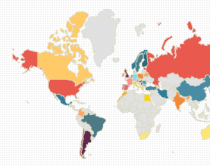
A world of R&D: what changed since the 80s?

In three decades the world can change of a lot. And it did: Cold War ended and several others started; new nations were born while globalisation kicked in. Yet one thing didn't seem to stop: growth of research. In the history of mankind there has never been as much scientific research as there is now, with millions of scientists and several thousands of institutions working every day. But if growth of science never stopped, it sure changed how science