Gamma-ray bursts (GRBs) are the most powerful explosions so far observed in the universe since the big bang. They are a frequent phenomenon (approximately an explosion per day) and can be observed in all sky directions (isotropic). Gamma-ray bursts can not be seen from Earth because gamma and X rays are absorbed by the atmosphere.
The Swift satellite mission is unique because the satellite can observe and measure the gamma ray bursts and point in their direction. Swift is a low orbit satellite located at about 500 km altitude and it takes just over 90 minutes to complete a full circle around the earth. In order to observe the gamma-ray bursts Swift is equipped with 3 telescopes : one telescope for GRBs detection (Burst Alert Telescope - BAT) and 2 telescopes, one X-ray telescope (X-ray Telescope - XRT) and one optical and ultraviolet telescope ( UV / Optical Telescope - UVOT) to follow the GRBs' afterglow over time. The 3 telescopes detect about 100 GRBs per year.
The satellite can detect both short and long bursts. The short bursts are probably due to the destructive collision of 2 neutron stars that get too close and collapse into a black hole. The long bursts are linked to the explosion of high-mass supernovae that turn a large size star into a black hole.
In order to send data, Swift uses the energy produced by the large solar panels installed on the satellite, whereas it uses momentum wheels to autonomously slew into the desired direction (military technology).
The NASA Swift app was conceived by Patrizia Caraveo, Head of INAF-Institute of Space Astrophysics and Cosmic Physics in Milan and Italian Co-Investigator in the Swift project. The app was developed by Giacomo Saccardo, a student at the University of Trento, during a visit to the Swift Mission Operations Center at Penn State University in State College, Pennsylvania.
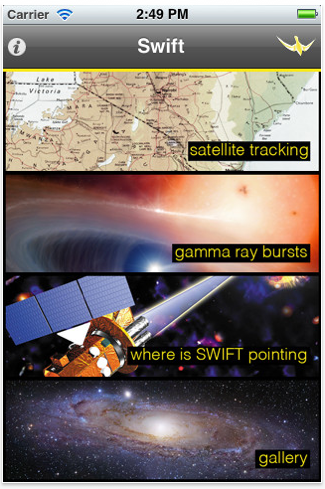
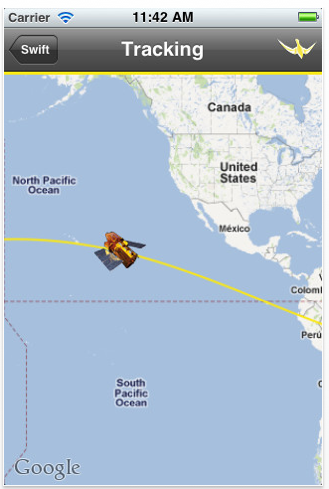
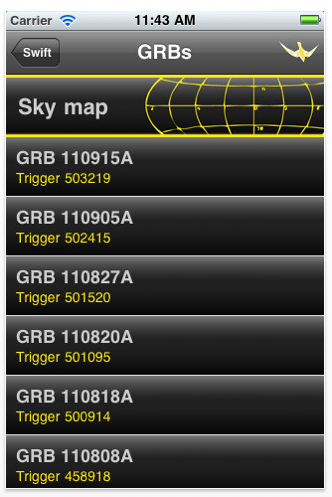
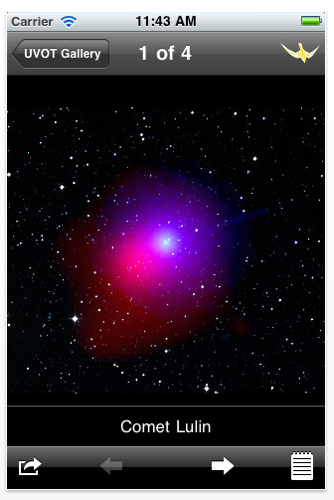
Images and data made available by the App are used by researchers to perform accurate calculations on the exact position of the flashes, but can also be used by amateurs. The less experienced users can extract useful information such as a list of the most recent GRBs detected and view them in a star map, and also view images related to GRBs and Swift operations. Professional users can read the technical data, obtain information on the satellite position and also information on where and what the Swift telescopes are pointing at.
One of the useful features of the app is to alert users with a message of any new gamma-ray bursts detected by Swift.
Video overview and previews of the app:
[video:http://vimeo.com/32367440]