An effective and practical expenditure of public funds can lead to excellence: Denmark can be seen as a case study for this. The small north European country is known for being the country with the highest public spending on education relative to GDP, namely 8.7% of the total. And probably will be known for being the most efficient country in gaining funds from Horizon 2020 (H2020).
That is basically what came out in October 29th, during the official H2020 launching conference in Copenhagen, where the 37 years old Minister for Science, Innovation and Higher Education Morten Østergaard revealed that his country targeted to reach more than €2 billion from H2020, namely 2.5% of the entire H2020 program (in the 7th Framework Program (FP7) Denmark reached the 2.36% of the total funds). His prevision was made on the prediction of about 14.000 submissions, of which 3.500 have to succeed. He based his plan on a careful study on the conduct of Denmark in the previous funding program.
Tab.: Denmark's results in the Seventh Framework Program.
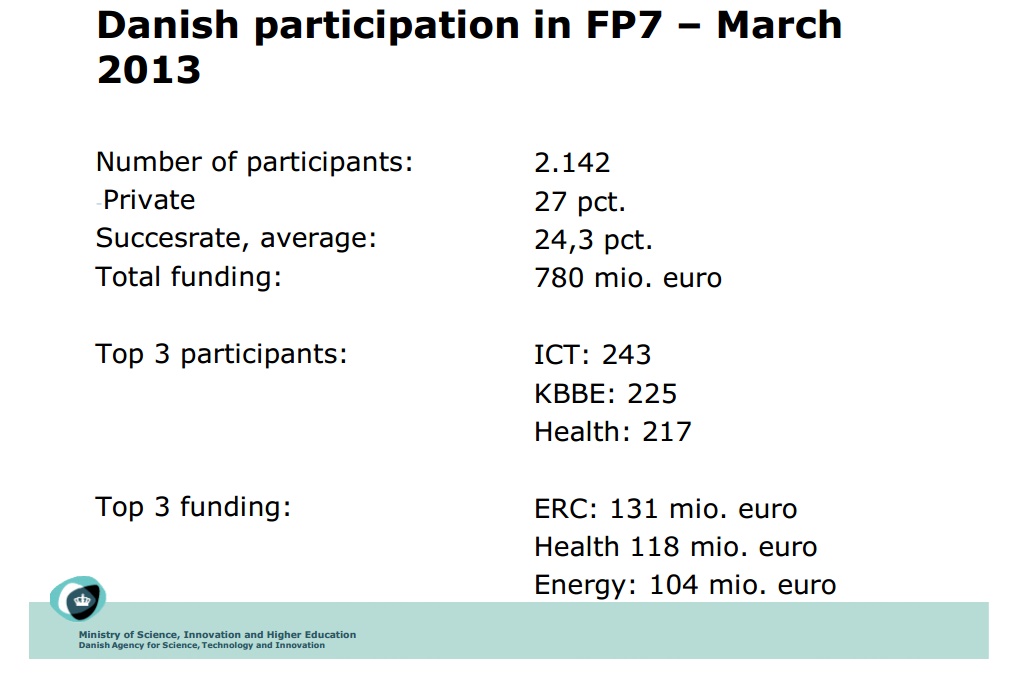
During FP7 Denmark reached extraordinary goals, due to a strong and effective governmental support. This support was made up of two main instruments, aimed to help national and international scientists in a nation (just 1% of the entire population of the Union) that feared to be overwhelmed by bigger countries.
The first instrument was a financial one, called EuopSTART, that “allocates grants for the preparatory work of Danish businesses and knowledge institutions with a view to participating in selected European and international research programs”. In particular, the average grant was up to 20.000 euro to each subscriber for the preparation of FP7 proposals and up to 8500 euro to each subscriber for negotiation of grant agreements. These grants were given to cover both salaries, travels and external assistance. The total amount of public money spent for this program was 1.5 million euro, less than 1% of the entire Danish GDP. Rumors say that it will be renewed in 2014 for H2020, as it has been very useful for researchers.
The second remarkable instrument was an advising program called “EU-DK support”, that gave targeted and coordinated services to all users on central EU-program. This kind of “virtual help-desk” is based on the “no wrong door” principle and basically solves all the main organizational problems that the researchers face during their run towards European grants (such as a brief and effective guide to H2020). Together with these general policies, many Danish “knowledge institutions”, like the University of Southern Denmark, already started workshops or practical meetings on the Horizon 2020 program. “Be ready” seems to be the motto of Danish academia.
But Denmark's efforts to excellence don't stop at the academic stage. One year ago, Denmark launched an innovative program, called “Denmark – a nation of solution”, to improve its innovation strategy of integration between scientific/research world and private sector. The innovation strategy is aimed to “ensure that more of Denmark’s knowledge and business positions of strength are translated to new jobs and growth”, that means to “support a more goal-oriented Danish approach to creating innovative solutions to global societal challenges”.
From words to facts: this October the Government and the other political parties have reached an agreement on the creation of a new foundation with the aim to put in practice the innovation strategy. This institution will be basically the union of the Danish Council for Strategic Research, the Danish National Advanced Technology Foundation and the Danish Council for Technology and Innovation into a single foundation, with 1.5 billion Danish crowns (about €200 million) budget per year.