On November 13th 2013, a new Eurobarometer survey showed a wide public support for responsible research and innovation in the European Union. According to the document Responsible Research and Innovation (RRI), Science and Technology, 77% of citizens from EU27 countries think that science and technology have a positive influence on society. However, they would like to take more into account ethical principles (76%), gender balance (84%) as well as public dialogue (55%). Between April 26th and May 24th 2013, 27563 citizens were interviewed.
In particular, 1016 Italian citizens were contacted face-to-face. Only 29% of them feels informed enough about science and technology (EU27=40%), but they are quite interested in their developments (IT=50%, EU27=53%). In general, they get less information than EU27 people through different media: television (IT=56%, EU27=65%), newspapers (IT=24%, EU27=33%), websites (IT=19%, EU27=32%), magazines (IT=20%, EU27=26%), radio (IT=8%, EU27=17%), books (IT=13%, EU27=14%) and social media (IT=10%, EU27=10%). Furthermore, 37% of Italians (EU27=31%) thinks that people should only been informed about decisions involving science and technology. On the other hand, 34% (EU27=39%) would like to be consulted or participate directly in the decision processes (IT=9%, EU27=12%).
According to the data evolution from 2010 to 2013, the best qualified Italian persons or organizations able to explain the impact of scientific and technological developments on society should be the scientists working at universities or government laboratories (IT=61%, -5% compared to 2010, EU27=66%), the scientists working in private company laboratories (IT=38%, +2%, EU27=35%), the environmental protection associations (IT=18%, -5%, EU27=21%) and journalists from television (IT=18%, +3%, EU27=20%). In general the three-years trend was positive for newspapers journalists (IT=15%, +2%, EU27=15%), industries (IT=4%, no variation, EU27=9%), writers and intellectuals (IT=4%, +1%, EU27=7%), but was negative for consumer organizations (IT=16%, -5%, EU27=20%), medical doctors (IT=14%, -10%, EU27=19%) and government representatives (IT=6%, -8%, EU27=6%).
Finally, In Italy the overall influence on science and technology is totally positive for 71% (EU27=77%) and negative for 15% (EU27=10%). In general, young people (82% of 15-24 years old) are more optimistic than 55+ years old people (65%). Other citizens (25-54 years old) are quite positive with more than 70%. The responsibility towards society exercised by paying attention to the impact of their science and technology related activity should be taken, first of all, by the environmental protection associations (IT=77%, EU27=81%), the scientists (IT=72%, EU27=82%) and the consumer organizations (IT=71%, EU27=76%). The government representatives could be good only for 34% (EU27=44%).
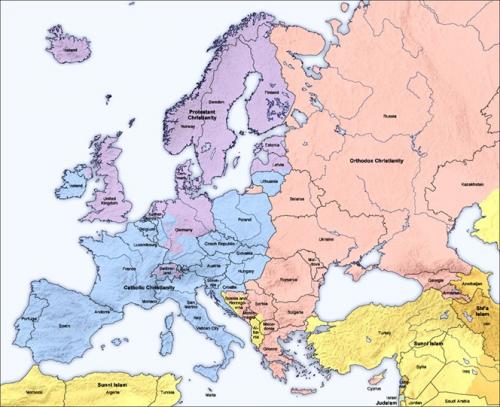
One of the questions of the new Eurobarometer was particularly interesting: Do we depend too much on science and not enough on faith? As reported in Fig. 1, people in Eastern and Mediterranean countries are more likely to agree that we depend too much on science and not enough on faith. This sentiment in these countries is more negative compared to 2010. In our country, 42% of respondents (+5% compared to 2010, EU27=39%) agree with it. On the other hand, 24% (-6%, EU27=32%) totally disagree. Finally, it is interesting to see that this picture is quite similar to the map of traditional religious majorities by region in Europe (see Fig. 2). Perhaps we could wonder if there are some differences due to Protestantism and Catholicism / Orthodox Christianity?
Fig. 1 - Do we depend too much on science and not enough on faith? Answer: Total agree (Credit: Eurobarometer 401).
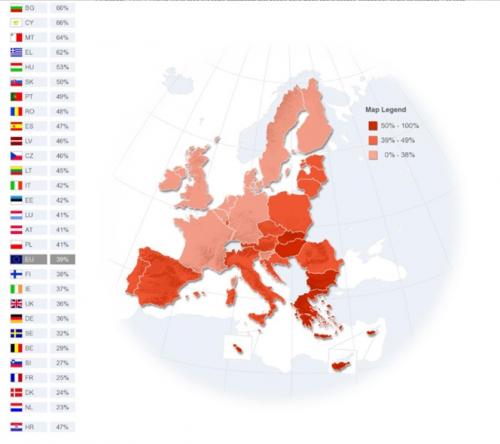
Fig. 2 - Map of traditional religious majorities by region in Europe (Credit: Eupedia).